
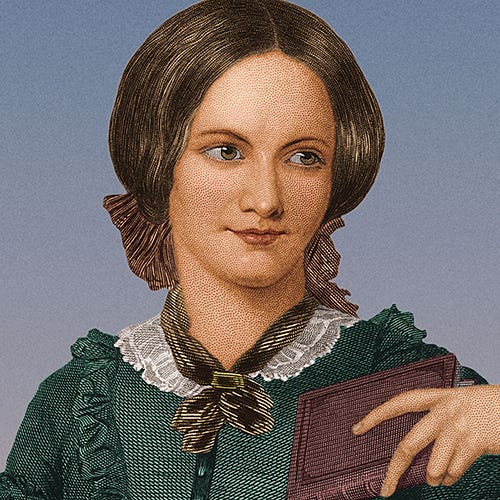
Charlotte Bronte
Biography
Charlotte Bronte (1816–1855) was an English novelist and poet, best known for her groundbreaking novel Jane Eyre. As the eldest of the famed Brontë sisters, Charlotte’s contributions to Victorian literature remain monumental. Her writing combined emotional depth, psychological realism, and feminist undertones, making her a lasting figure in English literary history.
Early Life and Education
Charlotte Brontë was born on April 21, 1816, in Thornton, Yorkshire, England, the third of six children to Patrick Brontë, an Anglican clergyman, and Maria Branwell Brontë. After her mother’s death in 1821, Charlotte and her sisters were sent to the Clergy Daughters’ School at Cowan Bridge, an experience that later influenced the harsh depiction of Lowood School in Jane Eyre.
She was largely educated at home, developing a passion for reading and writing from a young age. With her siblings—Emily, Anne, and Branwell—Charlotte created rich imaginary worlds, sparking her lifelong love of storytelling.
Early Career and the Path to Authorship
Before becoming a full-time author, Charlotte worked as a governess and teacher. Seeking financial independence, she and her sisters attempted to start a school but were unsuccessful. In 1846, under the pen names Currer, Ellis, and Acton Bell, the Brontë sisters published Poems by Currer, Ellis, and Acton Bell, which sold few copies but marked the beginning of Charlotte’s literary journey.
Major Works
Charlotte Brontë’s first published novel, Jane Eyre (1847), was an instant success. Its bold heroine, moral introspection, and Gothic overtones broke literary conventions and resonated with Victorian readers. It is now celebrated for its proto-feminist narrative and psychological complexity.
Her later novels include:
Shirley (1849) – A social novel set during the industrial depression, exploring class and gender struggles.
Villette (1853) – A semi-autobiographical tale of isolation, identity, and suppressed passion in a foreign land.
The Professor (posthumously published in 1857) – Charlotte’s first written novel, rejected during her lifetime.
Themes and Style
Charlotte Brontë’s work is known for:
Strong, independent female protagonists
Exploration of social class, gender inequality, and moral development
Use of first-person narrative to deepen emotional resonance
Gothic and Romantic elements fused with realism
Her novels often questioned Victorian ideals, offering a voice to women struggling for autonomy in a restrictive society.
Personal Life and Death
Charlotte’s personal life was marked by loss. She outlived all her siblings, losing Branwell, Emily, and Anne within a short period. In 1854, she married Arthur Bell Nicholls, her father’s curate. Tragically, she died less than a year later, on March 31, 1855, at the age of 38, possibly from tuberculosis or hyperemesis gravidarum, a severe pregnancy-related illness.
Legacy
Charlotte Brontë is revered as one of the most significant female authors in English literature. Jane Eyre remains a staple of literary curricula worldwide, studied for its narrative innovation, psychological insight, and critique of societal norms. Her influence extends into feminist literary theory, psychoanalytic criticism, and Gothic studies.