
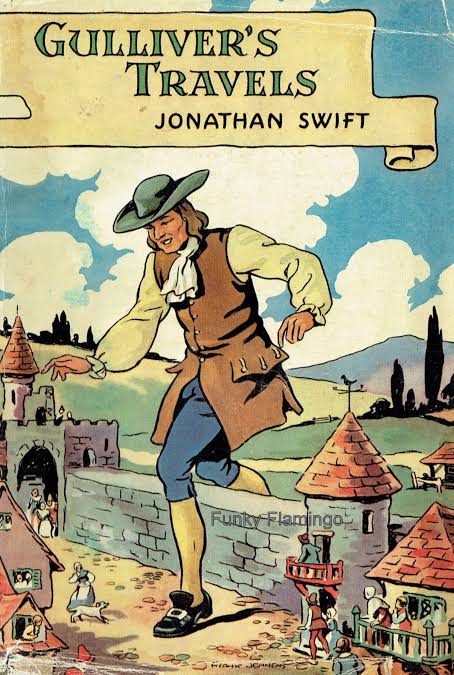
Jonathan Swift’s Gulliver’s Travels, published in 1726, is much more than a fantastical adventure story. Beneath its imaginative surface, the novel functions as a powerful work of satire. Swift uses the voyages of Lemuel Gulliver—to Lilliput, Brobdingnag, Laputa, and the land of the Houyhnhnms—not simply to entertain, but to expose and ridicule the political, scientific, and moral flaws of 18th-century European society.
As a satirical text, Gulliver’s Travels aims not only to criticize but to provoke thought and reform. Through irony, exaggeration, and parody, Swift examines human nature, power structures, and intellectual arrogance. Lets explore how Swift uses each of the novel’s four voyages to deliver biting satire on different aspects of civilization.
Lilliput: Satirizing Politics and Petty Power
In Gulliver’s first voyage, he arrives in Lilliput, a land inhabited by tiny people. Their small size immediately suggests the small-mindedness of their political ambitions and schemes. The conflict between Lilliput and Blefuscu over the correct way to crack an egg (from the small end or the big end) is a satirical jab at the religious wars and political disputes between Protestant England and Catholic France.
Swift also mocks the corruption and favoritism in court politics. Lilliputian officials gain power not by merit but by performing ridiculous rope dances, a clear metaphor for the obsequious behavior expected of politicians in royal courts. As literary critic Dustin Griffin notes, “Swift does not merely ridicule individual politicians, but the entire mechanism of political advancement” (Satire: A Critical Reintroduction, 1994).
Brobdingnag: A Giant Mirror to Moral Corruption
In the second voyage, Gulliver travels to Brobdingnag, a land of giants. This reversal of scale turns Gulliver into the tiny figure, offering a new perspective on human flaws. The Brobdingnagians are presented as rational and morally upright, in contrast to the corruption of European society.
When Gulliver proudly describes the weapons and warfare of his people, the King is horrified, calling Europeans “the most pernicious race of little odious vermin that nature ever suffered to crawl upon the surface of the earth.” This moment captures the moral satire of the novel: Swift critiques not only political systems but also the violence, pride, and greed that underlie so-called “civilization.”
Laputa and Lagado: Ridiculing Science and Intellectual Absurdity
The third voyage takes Gulliver to Laputa, a floating island inhabited by scientists and philosophers who are so obsessed with abstract theory that they are disconnected from reality. Swift’s satire here is aimed at the Royal Society and Enlightenment rationalism, which he believed had become impractical and self-serving.
In the Academy of Lagado, scientists attempt absurd experiments such as extracting sunlight from cucumbers or building houses from the roof down. These scenes parody the misguided optimism in scientific progress. According to scholar John Richetti, “Swift’s satire on science is not anti-intellectual, but a warning against the detachment of knowledge from human needs” (The Cambridge Companion to Jonathan Swift, 2003).
The Land of the Houyhnhnms: Human Nature Stripped Bare
Perhaps the darkest satire appears in Gulliver’s final voyage to the land of the Houyhnhnms, rational horses who live in a utopian society. Here, humans are represented by the Yahoos, filthy and brutish creatures driven by greed and lust. The contrast between the Houyhnhnms and the Yahoos forces Gulliver—and the reader—to confront the base instincts of human nature.
By the end of the novel, Gulliver becomes so disillusioned with humanity that he prefers the company of horses to people. This misanthropic conclusion is one of the most debated elements of the satire. Critics like George Orwell have argued that Swift’s pessimism is too extreme, while others, such as Claude Rawson, see it as an “unsparing but essential indictment of humanity’s moral failings.”
Conclusion: The Lasting Power of Satire in Gulliver’s Travels
Gulliver’s Travels remains one of the most enduring works of satirical literature because of its multi-layered critique of society. Jonathan Swift masterfully uses fantasy and irony to strip away illusions about politics, science, religion, and human virtue. Each voyage serves as a mirror—sometimes comic, sometimes grotesque—reflecting the absurdities and injustices of 18th-century Europe.
For students of literature, the novel offers rich ground for analyzing not just satire, but narrative technique, irony, and genre blending. Gulliver’s Travels is not simply a critique of Swift’s time, but a universal commentary on the follies of human behavior that remains sharply relevant even today.